


Yoko Arai: working in Japan for stronger adult education
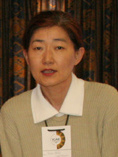 In mid-February, Yoko Arai, member of the Japan Association for Promotion of Social Education (JAPSE), visited Montevideo. JAPSE is the biggest organization working in the area of adult education in Japan, and it is a member of ICAE.
During her visit, Yoko established contact with education authorities in Uruguay and visited ICAE’s offices, where we asked her about the condition of adult education in Japan and her expectations regarding the VIII ICAE World Assembly to be held from 14 to 17 June in Malmö, Sweden.
Yoko told us that in Japan there was a sudden increase of privatization in the field of adult education, a tendency that started slowly in the 1970s and consolidated after 2003.Following the enactment of the Local Autonomies Act and the concession of the Ministry of Education and Science in January, 2005, some municipal governments started to get outsourcing finance as of 2006 for the administration of some public institutions of adult education.
One of the reasons of this tendency, Yoko explained, “is the municipal finances crisis that took place after the enactment, in 1995, of the Decentralization Act”, a measure taken by the central government with the purpose of reducing national public expenditures. According to the government, it was a “democratic” measure as it enabled to transfer responsibility in many areas from the central administration to local governments. But in practice, what the central government did was to interfere in the financial management of the local administrations. Due to the need that local governments had to reduce their own financial expenses, and according to the central government decisions, they had to introduce policies of privatization in many areas, including adult education.
Considering that the State has kept under control some areas of adult education (for example, family education, the one related to community participation, and vocational education), what can be seen in Japan is an actual division of adult education in two areas: a public one and a private one. According to Yoko, popular Japanese movements of adult education have historically helped to improve the professional level of the staff working in that area, mainly in the communities. On the other hand, recent decentralization and external financing policies in Japan generally lose sight of the importance of the staff and its freedom of practice for adult education, as what governs is a mercantilist practice of the activity. “We must publicly support adult education for it to be stronger, even under outsourcing policies in finance”, Yoko explained. “To achieve this it is necessary to work in two dimensions: the financing of adult education and the system of staff recruitment and training”.
In this context, Yoko awaits with expectation JAPSE participation in the next ICAE World Assembly, which she considers a great opportunity to establish more fluid contact with other representatives of the world movement for adult education. This meeting will make possible to share strategies and exchange information on different domestic experiences in other countries. This, Yoko concludes, could help in transmitting new ideas to other colleagues involved in adult education in Japan.











3 answers to Yoko Arai: working in Japan for stronger adult education
It is just excellant,i also want to apply for 3year deploma in technology and electronic
ReplyYouve got it in one. Couldnt have put it betetr.
ReplyGood to see a tleant at work. I cant match that.
ReplyLeave a Reply
Your email address will not be published. Required fields are marked *